 Sunlight
Guides
Sunlight Calculator: How Much Sun Does an Area Get?
Combine field observations with a simple geometric model to estimate direct-sun intervals at a specific outdoor point.
Define the measurement
Choose one point in a bed, patio or yard. Direct sunlight at that point is different from daylight, brightness, lux, meteorological sunshine duration and filtered light below leaves.
For a large area, repeat at the center and edges rather than assigning one total to the whole site.
Make a field sun log
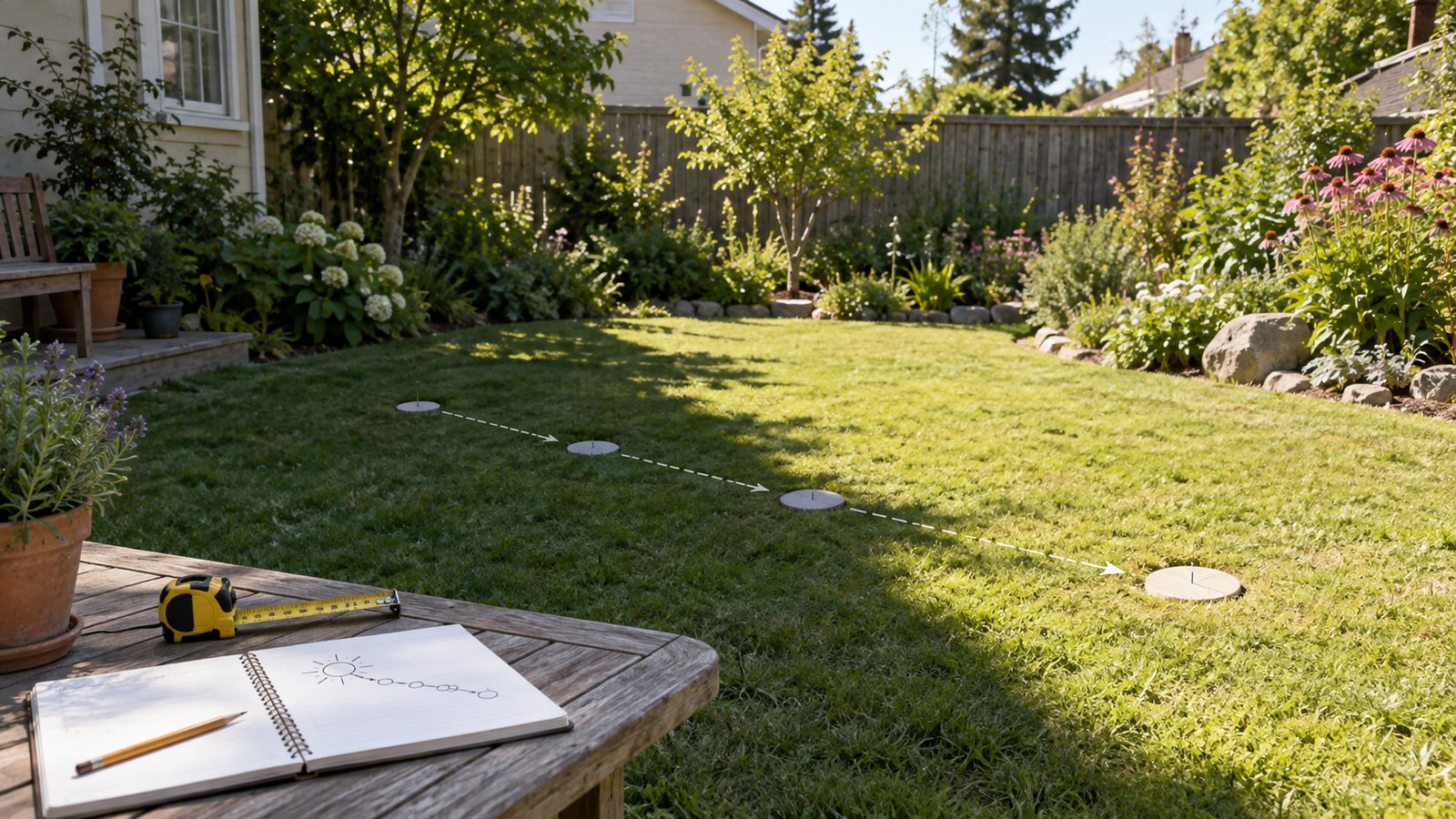
On a mostly clear day, check the marked point every 30–60 minutes and record direct sun, shade or uncertain filtered light. Add only intervals that were directly observed as sun.
Shorter checks improve the estimate near moving building or fence shadows. Repeat across seasons.
Build the simplest useful model
Enter latitude, longitude, IANA time zone and date; verify geographic north. Add nearby flat-roof blocks, solid fences and approximate opaque tree crowns with measured or defensible dimensions.
Do not add decorative detail. Test uncertain heights or positions as ranges.
Read the calculated intervals
The tool samples clear-sky geometry every five minutes and reports direct, shaded and night intervals for one ground point. Use the time slider to inspect when a shadow reaches it.
A boundary can fall between samples, so totals are approximate, especially near grazing edges.
Compare observation with model
Open the same local date and time as a field note. If the model disagrees on a clear day, review north, timezone, object position, dimensions and missing obstacles.
Cloudy observations cannot validate whether geometric shadow placement was correct.
Use plant labels as guidance, not physics
Extension services commonly describe full sun and partial shade with hour ranges, but plant response also depends on climate, heat, soil moisture and time of day.
The calculator does not recommend crops, measure photosynthetically active radiation or guarantee growth.
A few things to know
Does the calculator include clouds?
No. It models clear-sky geometry and opaque obstacles, not weather.
Is six hours always “full sun”?
It is a common gardening guideline, not a universal biological threshold. Check guidance for the plant and climate.
Can it model light through a tree canopy?
Only crudely: the crown is opaque and has no leaf density or seasonal translucency.
Does it measure indoor sunlight?
No. It does not model windows, reflections or indoor illumination.
Use the tool as a first step
Model the geometry, test uncertain inputs and verify important decisions outdoors.
Open the tool